- +44(0)1332 291972
- convertme@convert-av.com

Modern industrial organisations rely on thousands of critical assets moving continuously between manufacturing, assembly, storage and distribution. Yet many businesses still depend on manual processes, spreadsheets and assumptions when tracking high-value equipment, work-in-progress and operational assets.
Industrial: “Keeping critical assets moving starts with knowing exactly where they are what they’ve experienced.
If you don’t find what you’re looking for here, don’t hesitate to Contact us to discuss your specific requirements.
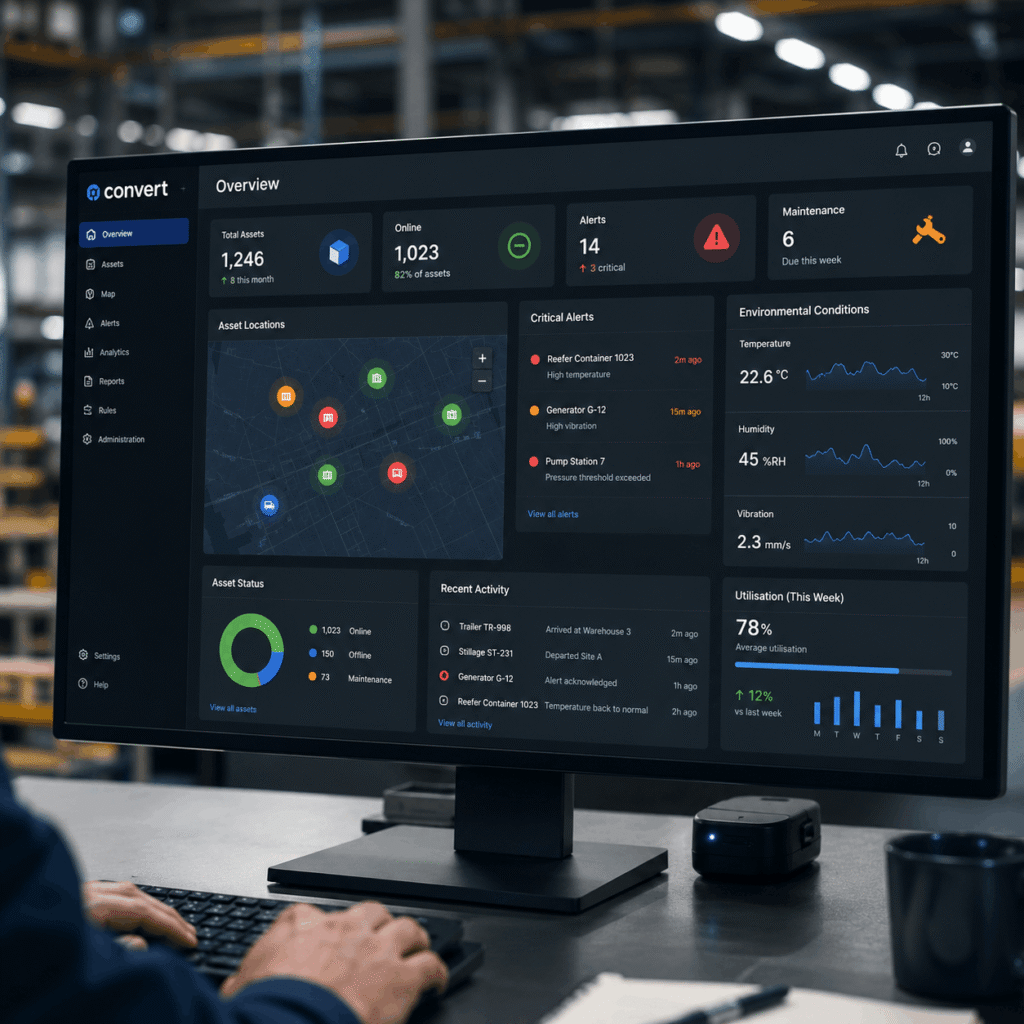
Many industrial organisations continue to operate with limited visibility of high-value assets as they move between manufacturing facilities, warehouses, project sites and customer locations. Without accurate, near real-time information on asset location and status, valuable equipment can be misplaced, underutilised or remain idle for extended periods, resulting in unnecessary capital expenditure and operational inefficiencies.
The loss or misplacement of stillages, returnable transit equipment (RTE) and other reusable logistics assets represent a significant hidden cost across many supply chains.
Replacing these items, together with the administrative effort required to locate them, increases operating costs and disrupts production.
Many inspection and compliance activities continue to depend on manual processes, paper records and spreadsheet-based reporting. These approaches are time-consuming, prone to human error and provide limited assurance that critical assets remain safe, compliant and available when required.
Staff Time Spent on Manual Inventory Audits.
Many organisations continue to rely on manual inventory audits, consuming valuable staff time while providing only periodic snapshots of stock accuracy rather than continuous visibility.
Production Delays Searching for Critical Assets.
Production schedules are frequently impacted by delays in locating critical components, tools or work-in-progress items. Even short interruptions can create bottlenecks across manufacturing operations, reducing productivity and affecting customer delivery commitments.
Increase in Maintenance Costs from Reactive Failures.
Machinery and sensitive equipment often operate without continuous monitoring of environmental conditions such as temperature, humidity, vibration or shock. Operating outside recommended limits can accelerate wear, compromise product quality and increase maintenance costs.
Reduction in Emergency Response Effectiveness.
Worker safety is another growing priority, particularly where employees operate alone, in hazardous environments or across remote sites. Limited visibility of personnel and equipment can delay emergency response and increase operational risk.
Convert’s intelligent asset monitoring platform provides organisations with continuous visibility of the location, condition and utilisation of critical assets throughout their operational lifecycle. Combining secure wireless connectivity with environmental sensing and intuitive software, the platform enables informed decision-making through near real-time data rather than manual reporting.
Asset Tracking
Locate high-value assets, returnable transit equipment, tools and work-in-progress items across multiple facilities and operational sites.
Inventory Management
Improve stock visibility and automate inventory reporting to reduce manual audits and improve asset availability.
Environmental Monitoring
Continuously monitor temperature, humidity, shock, vibration and other environmental conditions affecting equipment and products.
Predictive Maintenance
Identify developing equipment issues through condition monitoring, enabling planned maintenance before failures occur.
By replacing manual processes with continuous digital visibility, organisations gain greater control over their operations while significantly reducing the time and effort required to manage critical assets.
Automated data collection eliminates many routine administrative tasks, allowing engineering, logistics and operational teams to focus on higher-value activities rather than searching for equipment, conducting manual audits or updating spreadsheets.
Improved visibility across the organisation enables better operational planning and more informed decision-making.
Knowing where assets are located, how they are being utilised and the environmental conditions they have experienced reduces uncertainty throughout the supply chain, helping to minimise production delays, improve inventory accuracy and increase overall asset availability.
Continuous environmental and condition monitoring supports a more proactive maintenance strategy.
Rather than relying solely on scheduled inspections or reacting to equipment failures, organisations can identify potential issues earlier, reducing unplanned downtime, extending asset life and lowering maintenance costs. Historical condition data also provides valuable evidence when investigating failures or supporting warranty and insurance claims.
The platform also delivers measurable financial benefits through improved asset utilisation and reduced losses.
High-value equipment, tools and returnable transit assets remain visible throughout their lifecycle, reducing unnecessary replacement costs while maximising return on existing capital investment. Better utilisation often removes the need to purchase additional assets simply because existing ones cannot be located.
Safety and compliance are strengthened through the automatic collection of trusted operational data.
Digital records provide a comprehensive audit trail that supports quality management systems, regulatory compliance and customer assurance, while improved visibility of personnel and equipment helps organisations reduce operational risk and respond more effectively to incidents.
A combination of real-time visibility, environmental intelligence and data-driven decision-making.
Enables organisations to operate more efficiently, helping to reduce operating costs and build a more resilient, productive and sustainable business.
Quick and easy to install.
Location: Can achieve <2 Metres accuracy, works across multiple floors (3D) in complex indoor/outdoor environments.
Anchor Density: In general, 1-2 anchors required per room to increase precision, max anchor line of sight range <200m (outdoors), anchors can be operated by battery (rechargeable), solar or Power over Ethernet.
Ease of Use: Easy to install, setup and configure via mobile app, current installations 1 to 2 days, including training personnel.
Low power and long-life battery operation makes installation and management quick and easy.
Offers payback within one year.
We want to engage channel partners to help shape the solution to their needs, ready for integration into their systems. As such, we are now able to offer a technology demonstration system available to interested parties, which can be installed quickly and easily in your preferred location or environment, for testing and validation purposes.